Ask someone what a community needs most, and clean water rarely tops the list of what people expect to hear. But in East Africa, it’s often the single factor that determines everything else: whether a girl stays in school, whether a family stays healthy, whether a community can build toward anything beyond survival.
At Global Development Project Kenya (GDP Kenya), we’ve come to believe clean water isn’t just one program among many. It’s the foundation everything else is built on.
The Water Crisis in East Africa
The scale of the challenge is significant. According to UNICEF, nearly 40% of the population in some East African countries still struggles to access clean water, a gap that leads to widespread waterborne disease and high child mortality.
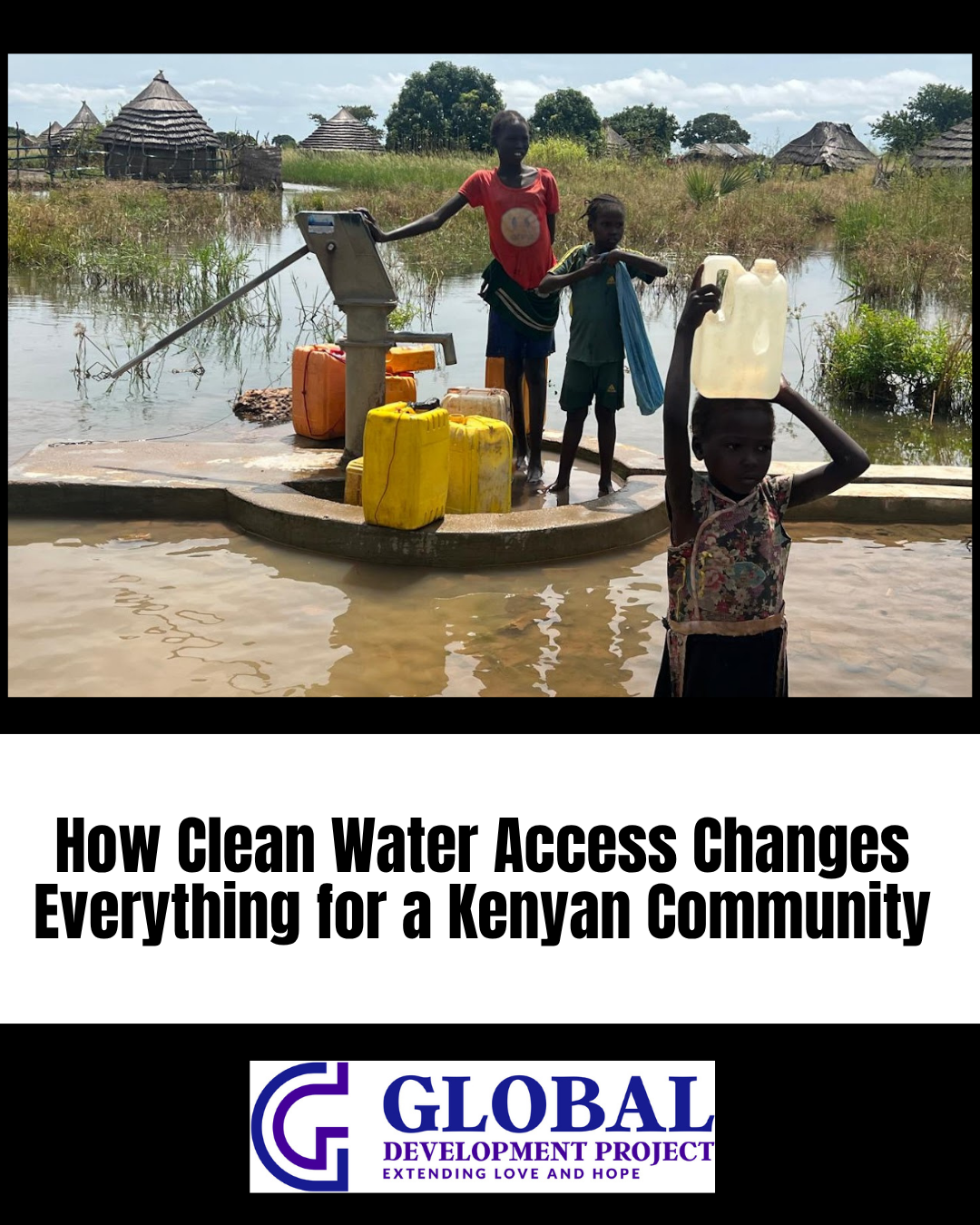
But the numbers only tell part of the story. In rural and isolated communities, women and children often spend hours every single day walking to the nearest water source, time stolen directly from school, work, and family life. And when the water at the end of that walk is contaminated, the risk doesn’t end when the walking does: waterborne disease from unsafe sources remains one of the leading causes of preventable child mortality in the region.
GDP Kenya’s Answer: Infrastructure That Lasts
GDP Kenya’s clean water program is built around solutions that are proven, durable, and designed to last for generations: not short-term relief, but permanent community infrastructure.
Borehole installation. GDP Kenya identifies communities in the most urgent need and installs deep boreholes that access clean groundwater beneath the surface. Each borehole becomes a permanent, community-owned water source, eliminating dependence on distant rivers, open wells, and contaminated surface water.
Solar-powered pumps. Every borehole is paired with a solar-powered pump system, harnessing renewable energy to lift and distribute water without relying on costly fuel or a electrical grid that often doesn’t reach these communities. That means the water keeps flowing reliably and sustainably for decades.
Integration with children’s homes. GDP Kenya’s partner children’s homes, caring for 590+ children daily across Kenya, are part of this same clean water network, ensuring that some of the most vulnerable young people in our care have consistent, safe water as a foundation for their health and development.
From Your Gift to Flowing Water: How It Actually Works
Here’s exactly what happens when a community receives a GDP Kenya borehole:
- Community identification. GDP Kenya’s Kenya-based team evaluates water access, health data, population density, and geographic isolation to determine where a borehole will save the most lives.
- Borehole drilling. GDP Kenya’s construction team, led by engineer Greg Hoffmann, who brings over 20 years of Kenya infrastructure experience, drills to reach clean, uncontaminated groundwater, with depth and location guided by a hydrogeological survey.
- Solar pump installation. A full solar-powered pump system is installed, including panels, motor, storage tank, and tap points, and water quality is tested before and after installation by a certified laboratory in Nairobi.
- Clean water flows. Community members who once walked hours for water now have it at the tap. GDP Kenya continues to maintain the system and monitor water quality to keep the supply safe for generations.
Why Clean Water Changes Everything Else
As Michael Wright, GDP Kenya’s Co-founder, puts it: “For us at GDP, clean water is not an option. It is a lifeline — and every family deserves one.”
That lifeline reaches further than health alone. When women and children no longer spend hours each day walking for water, they can attend school, participate in GDP Kenya’s Women’s Empowerment summits, build businesses, and lead their communities. Clean water and women’s empowerment are inseparably linked in this work, and the same communities served by the clean water program are often the same ones reached through GDP Kenya’s humanitarian aid and children’s care programs. These efforts reinforce each other by design.
Today, more than 2,000 people have daily access to clean water because of this work, part of GDP Kenya’s 35+ years of trusted operations in Kenya. In 2026, GDP Kenya has set a $46,000 clean water expansion goal to reach even more isolated communities.
Frequently Asked Questions
How does GDP Kenya provide clean water? GDP Kenya installs boreholes paired with solar-powered pumps in isolated communities across Kenya, providing permanent, community-owned access to clean groundwater without dependence on fuel or the electrical grid.
How many people currently have clean water because of GDP Kenya? More than 2,000 people currently have daily access to clean water through GDP Kenya’s borehole and solar pump installations.
Who leads GDP Kenya’s clean water construction? GDP Kenya’s clean water infrastructure is built by a construction team led by engineer Greg Hoffmann, who brings more than 20 years of Kenya infrastructure experience to each project.
How is water quality tested and maintained? Before and after each installation, water quality is tested by a certified laboratory in Nairobi. GDP Kenya continues to monitor and maintain each system to keep the water supply safe for generations.
Why is clean water connected to women’s empowerment and education? When women and children no longer spend hours each day walking to distant water sources, that time can go toward school, work, and community involvement, including GDP Kenya’s Women’s Empowerment summits, which reach 5,500 women annually.
How can I support GDP Kenya’s clean water program? You can fund a borehole or contribute toward GDP Kenya’s 2026 clean water expansion goal of $46,000 by visiting gdpkenya.org. GDP Kenya is a registered 501(c)(3) nonprofit, and all donations are tax-deductible.

